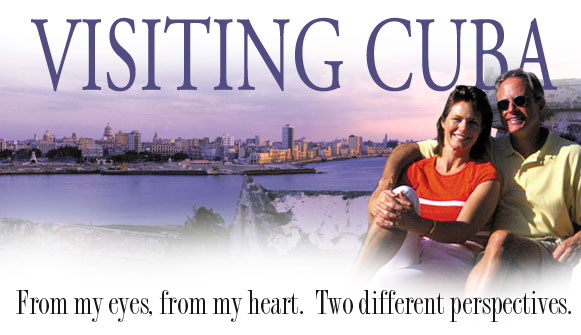
When I first arrived in Havana, my first thought was that I
must be out of my mind. Why on earth did I come? What could I possibly
write about visiting this city? Growing up in Miami I have lived with
Cuban people most of my life. And to further put this into perspective,
when the first Cubans arrived in Miami in 1959 it was a small southern
town with a population of approximately 270,000 people and, like most
southern cities, it was a racially segregated city. So to most white
Miamians, Cubans represented a culture as foreign to us as an alien
from Mars. As the city grew and cultures blended, our small town southern
thinking changed as rapidly as the rest of the world. I have always
felt fortunate to have grown up in Miami in such a vibrant and alive
city that thrives on challenges and controversy and has withstood
a lifetime of change.My first reaction to stepping on Cuban soil was
a combination of both excitement and fear. Although I expected police
and military, it is so unexpected to see police on just about every
corner that my nerves were on edge and I was a bit jumpy.
|
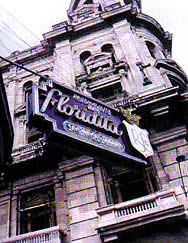
Floridita Bar
|
To my eyes Havana seemed so surreal, so poor and so deteriorated,
I thought I would never make it through the visit with my sanity in
tact. My imagination was getting the best of me. When I realized that
I was overreacting to the culture I grew up in and needed to be objective
I began to relax. So I did what any good tourist would do. I visited
one of the popular tourist spots, Floridita, HemmingwayÕs favorite
bar. From the outside, Floridita looked like most of the buildings
in Havana, old and sadly neglected. But once inside everything was
different. The interior was rich with history and quite elegant. The
bar area was festive with photos of Ernest Hemingway and a host of
famous Americans who frequented the bar in the 1950Õs. The restaurant
adjacent to the bar made me feel like I was on the set of an old Hollywood
movie. The house specialities are Mojitas and Daiquiris both made
with Havana Club Rum. As we sipped on our daiquiris I began to relax
and observe the other tourists who surrounded us. They were all having
fun. So what was wrong with me? An older womanapproached us to buy
a souvenier and I was moved by her humbleness when I agreed to purchase
a CD of the barÕs favorite music. She was pleased to find out we were
American and, in our own attempt to communicate, we spoke in broken
English and Spanish to each other. Her simple act of kindness affected
me in a very profound way.After leaving the safety net of Floridita,
we ventured out into the streets of Havana. I donÕt know if it was
the effect of the Havanna Club on my nerves, but slowly as I was able
to adjust to the surroundings I could see the incredible beauty of
the City of Havana and what the city once was. It was a very moving
experience that embraced me, one of awe and one of regret. To me Havana
represented a city of sorrow, for all that it was and lost and for
all that it should be. The history, the architecture, the monuments,
the cobblestone roads, worked its magic and I fell under its spell.
It was at that very moment I realized that regardless of politics,
you can see and appreciate Havana as an American tourist because the
city is a grand dame of palatial mansions, elaborate colonial forts,
churches and boulevards with decorative lighting. It was at the moment
that I fell in love with Cuba.Havana needs tourism for its economic
survival. It is a proud city with gracious character and the Cubans
who reside there have a deep national pride. From the poorest sections
and the most humble of homes, the Cubans smile from their hearts and
welcome visitors with a warmth and grace of a richer culture. It is
humbling to experience this when we have so much in America and they
have so little. The people of Havana pull at your heartstrings. Their
passion and love of their country gives the city a life and rythmn
of its own.
|
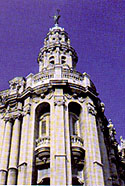
The Gran Teatro
|
I am not a history buff, nor someone who has a formal education in
architecture, but from my personal perspective I would rank the architectural
importance of Havana as I would Venice, Paris or Rome. In spite of
the devastation of the buildings, I was in awe of each and every one
of them, street after street. When you enter open doorways you find
unexpected courtyards housing museums, hostels, restaurants and artistsÕ
work shops. In CastroÕs Cuba, nothing makes sense and everything touches
your heart. The streets of Havana were crowded with tourists. We found
many Italians, some French, English, Canadians, and an occasional
American. My husband and I were sitting at Cafe El Meruiro, an outdoor
cafe on the plaza that overlooks the seaport, a main attraction for
locals and tourists, when we spotted a t-shirt that said Ohio State.
I visited the table to ask the three young men sitting there if they
were Americans and found out they were American students preparing
to make a presentation the following day of their observations of
Havana. I asked what their observations were, and their reply was
Òwe really donÕt know.Ó They were staying in Cuba for six weeks and
were having the same difficult time adjusting to the two emotions
Havana provokes in you: the historical beauty and the incredible sadness
of its current state.Music is very much a part of the Cuban culture
and on one of our stops at an outdoor cafe a wonderful musical trio
serenaded our table. When one of the men realized we were American
he shared his own personal story about his mother leaving Cuba to
move to The United States. He spoke about how much he missed her.
We were told this again and again by Cubans we met and the stories
they shared in sadness and hope. During our stay we hired a car to
drive us around the outskirts of Havana so we could see the surrounding
residential areas. We were fortunate to ride in a brand new air conditioned
Mercedez driven by Pedro, who spoke enough English to make our journey
interesting and informative. We drove to two residential areas, Miramar
and Ciboney. Here the homes were stately and resembled the Mediterranean
homes of Coral Gables, with large yards, gated entrance ways and,
unfortunately, armed personal security guards who are identified by
their green uniforms. Each of these areas had beautiful churches,
social clubs, and many of the renovated homes serve as official residences
for foreign embassies. It is rumored that Castro resides here, although
locals do not know exactly where. It is said that his residency changes
often for security reasons. As we continued our tour, Pedro, was shocked
that we live in Miami and do not speak Spanish. We found out PedroÕs
mother lives in Ft. Lauderdale. He asked me to phone her on my return
and tell her that he was fine and awaiting her call. I snapped off
a photo of him so I could send it to her on my return, and he was
touched and grateful for this gesture. He suggested we drive to see
HemmingwayÕs Marina, which we did. Here you find sailboats and yachts
from around the world, including the United States. There were also
new hotels and a new social club. Later that evening, at the suggestion
of a friend, we dined at a local restaurant, El Ajibe in Miramar that
was a combination of an indoor-outdoor restaurant built of bamboo
much like an upscale tiki hut. Once again, we were faced with the
challenge that we were the only Americans and we did not speak Spanish
and no one spoke English. Our wine steward simply stated that chicken
was the specialty and that was that. We were given a choice of Cuban
or Spanish white wine and chose a Cuban Pinot Grigio, which was surprisingly
good. We were served family style with rice and beans, plantains,
glazed chicken and salad. The meal was both generous and good. We
stayed at The Hotel Nacional de Cuba in Havana, which is the oldest
and grandest hotel in Havana. We stayed on the 8th floor, which is
where they house most Americans. It looks good from the outside and
less so from the inside. The hotel itself is old and lovely, although
its five-star status did not live up to our expectations of a five-star
hotel. ItÕs not architecturally as grand, but in some ways you can
compare it to Coral GablesÕ Biltmore Hotel. The best feature of The
Hotel Nacional is the outside veranda off the main lobby where you
find people relaxing, enjoying local musicians, and sipping either
a coffee or a cocktail. The veranda provides interesting people-watching
and bird-watching too, as the hotel has a collection of peacocks and
roosters strolling the grounds. The Nacional has two pool areas, excellent
dining options, and well kept grounds overlooking the Malecon and
the ocean. You can better understand the state of the economy when
you enter the guest rooms. They are large and clean, but not modern.
The beds are very low to the ground with hard mattresses that are
cell like. Soap is very scarce and you are given a bath soap smaller
than the size of a business card. Tissue is also a luxury and you
are given only an individual package. I forgot my toothbrush and it
took a trip to HavanaÕs newest hotel, the Golden Tulip, to find one.
All the day to day things that we take for granted are luxury items
in Havana. Telephone communications out of the country are very good;
however, it is very difficult to receive a call. The Golden Tulip
Hotel is bright, modern and very much in demand with the international
hotel traveler. It is located in the heart of Old Havana and its central
location provides excellent options to tourists who want to see Havana
by foot. We stopped to have refreshments in the lobby and to people
watch. The guests appeared to be more sophisticated and less artsy
than the Hotel Nacional crowd. At the suggestion of our hotelÕs concierge,
we dined at Monsignor Restaurant across the street from The Nacional.
We were the only Americans and, once again, no one spoke English.
The restaurant looked like it was out of a Frank Sinatra movie, with
the decor in white, red and black. We listened to an excellent pianist
and let our waiter order for us. We were introduced to our first Cuban
Chardonnay, which was good. We enjoyed excellent appetizers, although
we have no idea what they were, and an assortment of lobster, beef
and pork for our entree. The food was excellent, particularly the
pork. It was a very enjoyable meal served by very hospitable people
in an era that is long past in the United States.The only negative
comment we had about our first night on the town, besides not knowing
if we ate manatee appetizers, is that everyone in Cuba seems to smoke.
Cigarettes and cigars are everywhere, from cafes, to bars, to restaurants.The
next morning at breakfast (included in the price of the room), there
was a very large buffet. With the exception of orange juice, papayas
and eggs, the identity of the food was quite foreign to us.
|
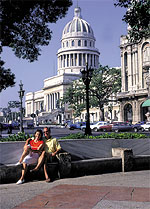
The Capitol in Havana
|
During the day we visited the Capitol area of Havana and, once again,
the architecture was impressive. It was impossible to enjoy a stroll
on the streetbecause we were stopped every few minutes and solicited
by someone for something. There were people soliciting a bicycle taxi
tour, a horse and buggy tour, a visit to the cigar factory, and everything
else under the sun. Most Cubans were impressed that we were Americans
visiting their country, although they did not like the fact that Elian
has not been returned to Cuba. One of the most surprising parts of
visiting this part of the city is to see the living conditions that
surround all four corners of the Capitol building. IÕm not sure words
can describe the condition of the homes in the once beautiful buildings,
but to sum it up would be to imagine the worse streets in Harlem with
people living in condemned buildings across from our nationÕs Capitol.A
trip to the flea market, with local artists and vendors, was highly
recommended. It is a colorful arts and craft area in the middle of
a street. You find paintings, woodcarvings, hand-made clothes, and
all sorts of locally made items. If you love to shop for bargains,
HavanaÕs flea market is great. The most disturbing part of this area
is to witness the number of older people begging. Although it happens
everywhere, the level of desperation seemed to be more severe. The
fort that once protected Havana has the most beautiful view of the
city. Moro Castle is in excellent condition and is a popular tourist
attraction. Our visit took us to a cigar factory in the fort where
some of the worldÕs best cigars are still hand made. If youÕre visiting
for the purpose of buying cigars, the admission fee is waived. In
the streets of Havana, you see children playing with wood sticks and
ragged balls, which is their form of baseball. There were kids on
hand-made wooden scooters, young women with castanets walking the
street, all busy with their normal day-to-day lives. The other side
of Havana for me was a city of sorrow, a city of tears.A once great
city is now crumbling before every visitorÕs eyes, and the residents
of this proud and beautiful city live humbly in small, dark rooms
hardly fit for habitation.
|
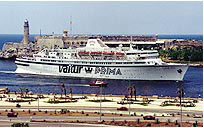
Valtur Prima entering the Harbor in Havana
|
By air or by sea, there are many ways to get to Havana and I can tell
you that I have tried three different options. Having said that, I
highly recommend visiting Havana by cruise ship. There is an Italian
cruise ship, the Valtur Prima, which sails from Montego Bay and visits
Cuba and other Caribbean Islands. Havana is its main port-of-call,
providing guests with close to two days to tour the city. The ship
is a luxury-liner with large guest rooms and every conceivable amenity.
From spa service to disco to shows, the Valtur Prima lives up to your
expectations, and more. The crew is a combination of Cubans and Italians,
and they are more than accommodating to guests. I was quite impressed
with the Cuban crew and, unlike most of the service people on-island,
most of the crew were educated at the University of Havana and spoke
English. The ship docks in the center of Old Havana, making it convenient
to walk the city or arrange for a city tour. The price of the cruise
is quite reasonable ($1079 for seven nights) when you factor in that
all meals are included with complimentary wine with lunch and dinner.
And of course there is plenty of entertainment, activities and theme
parties that are also part of the cruise.Other options are to fly
direct to Havana on one of the charter flights from Miami( only legal
under certain circumstances). This is the most convenient from the
standpoint of time, but if youÕre not used to being treated like cattle,
I wouldnÕt recommend it. I also flew to Montego Bay on Air Jamaica
and connected to their flight to Havana. The only problem with this
method of transportation is that you can expect delays in Montego
and the actual time it takes to reach your destination. Many Americans
fly into Jamaica, Grand Cayman and Mexico to connect to Havana without
legal documentation. The Valtur Prima is the only transportation to
Havana that is legal to American Citizens through its fully hosted
program.For those with legal permission to visit Cuba, The Hotel Nacional
charges between $150- $190 per night. Cocktails in town average $6.00
and you can count on spending $75 or more per for a good dinner including
a bottle of wine. |
|